When moisture appears at a foundation wall, the first question is often, “Which coating should we use?” A better first question is, “What water conditions is this wall expected to face?” That distinction is the practical starting point in any dampproofing vs waterproofing conversation.
The two terms are related, but they should not be treated as interchangeable. Selecting a below-grade product without understanding the site can leave important questions unanswered about drainage, water pressure, cracks, substrate condition, and the rest of the foundation system.
For a contractor, property manager, or building owner, the goal is not to choose the strongest-sounding label. It is to identify the conditions and match them to the project requirements and the documented capability of the exact product.
Dampproofing vs waterproofing in plain language
Dampproofing is generally discussed where the objective is to help limit moisture movement through a foundation or other exterior surface. Waterproofing is a different project requirement, particularly when the assembly may face more demanding water exposure or pressure.
This is not a universal design rule or a substitute for the project specification. Codes, drawings, soil conditions, drainage design, building use, and local requirements may define what the project needs.
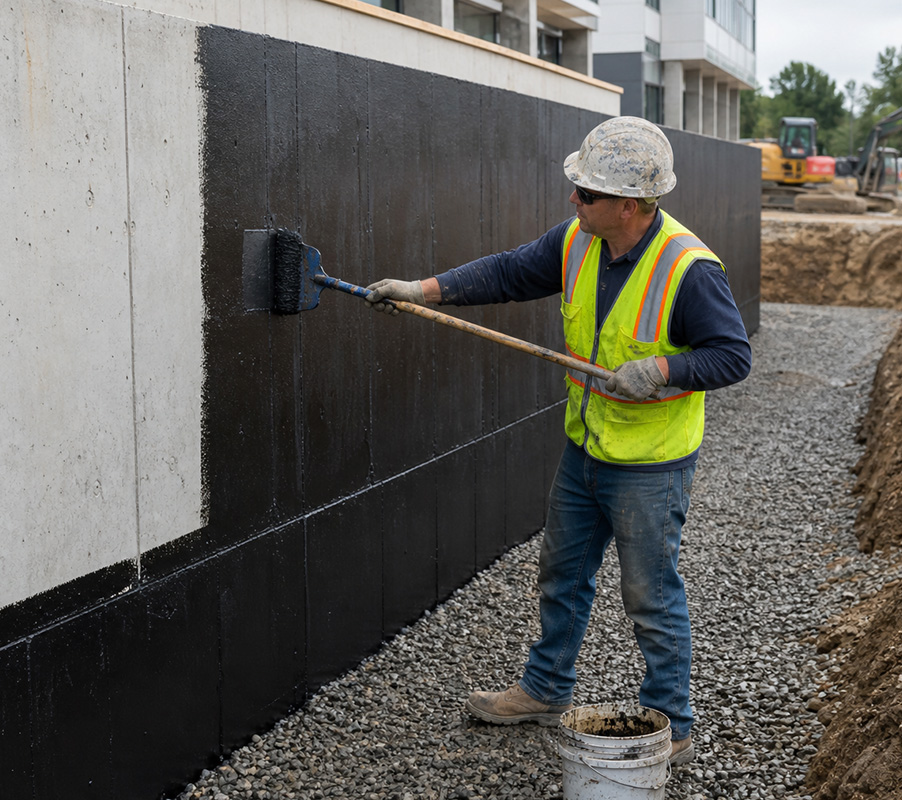
The practical takeaway is straightforward: a product labeled for dampproofing should not automatically be represented as a waterproofing system. Likewise, the presence of a black coating on a foundation wall does not tell you how the complete below-grade assembly was designed.
Start with the water conditions
A foundation beside well-drained soil may face a different moisture condition from a wall near a high water table, poorly draining soil, a failed drain, or recurring surface runoff. Those differences affect the decision before a pail is opened.
Hydrostatic pressure is water pressure acting against the foundation. In ordinary terms, water is not simply making the soil damp; it is collecting and pushing against the wall or floor. A routine coating should not be expected to correct the source of that pressure by itself.
Before selecting a material, determine whether the concern involves:
- Normal soil moisture or intermittent dampness
- Surface water directed toward the building
- Poorly draining soil or a blocked drainage path
- A seasonally high or consistently high water table
- Recurring water accumulation against the foundation
- Cracks, joints, penetrations, or transitions that require separate treatment
If the water condition is uncertain, the right next step may be an evaluation by the contractor, designer, or other qualified building professional—not an assumption based on a product category.
Evaluate the complete foundation project
A below-grade coating is one part of a larger moisture-management plan. The foundation material, surface condition, structural movement, penetrations, drainage, protection, and backfill process all affect the outcome.
Begin by identifying whether the surface is concrete, masonry, steel, or another documented substrate. Note whether it is new, slightly damp, fully dry, dirty, damaged, previously coated, or difficult to access. The Palmer product sheets do not give one preparation rule for every product; some identify damp-surface use while others call for clean, dry surfaces.
Also review:
- Visible cracks, voids, honeycombing, joints, and penetrations
- Footing, wall, slab, and service-entry transitions
- Exterior drainage and where collected water will go
- Protection of the finished coating before and during backfill
- Backfill material and the risk of damaging the treated surface
- Weather and temperature during application and drying
- The architect’s, engineer’s, or owner’s project specification
A coating cannot create drainage slope, repair structural movement, remove water pressure, or replace a required drainage or protection component.
Dampproofing vs waterproofing: how BULLDOG product families differ
Palmer Asphalt manufactures several BULLDOG products for dampproofing and related exterior uses. Their names help organize the category, but the current data sheet for each product controls the selection.
Water-based emulsion dampproofing
#41AF BULLDOG Semi-Mastic Emulsion Dampproofing, #42 BULLDOG Non-Fibered Emulsion Dampproofing, and #43AF BULLDOG Mastic Emulsion Dampproofing are water-based asphalt-emulsion products with different consistencies and documented application roles.
Their sheets distinguish brush or spray grades from a heavier trowel-grade mastic. They also address details such as slightly damp or “green” masonry surfaces, reinforcing-membrane use for certain products, weather limits, and drying before backfill.
These differences matter. “Emulsion” identifies a water-based product family; it does not make every member of the family interchangeable.
Solvent-based dampproofing
#601AF BULLDOG Mastic Dampproofing Cement, #602AF BULLDOG Semi-Mastic Dampproofing, and #603 BULLDOG Non-Fibered Dampproofing are solvent-based products documented for exterior surfaces below grade.
Their sheets distinguish a heavy trowel-grade mastic, a heavy brush-grade coating, and a non-fibered liquid coating for applications where a heavy compound or reinforcing membrane is not intended. The listed substrates, primers, preparation, application methods, and reinforcing roles vary.
That is why a contractor should match the exact surface and system role to the exact sheet rather than selecting from consistency alone.
Specialized and related products
#45 BULLDOG Foundation Coating is documented for exterior substructural and foundation surfaces above or below grade. Importantly, its sheet states that the product is not intended to withstand high hydrostatic pressure. That limitation illustrates why water conditions must be established first.
#44AF BULLDOG Bitustatic Compound has a different set of documented exterior uses, including walls, flashings, parapets, gutters, and slate-tile embedding. #84 BULLDOG Black Asphaltum Paint and Primer is documented for dampproofing and corrosion or decay protection on certain metal or masonry surfaces.
These products expand the available application range, but they should not be presented as routine substitutes for one another or for a project-specified waterproofing assembly.
Mastic, semi-mastic, and non-fibered are not rankings
It can be tempting to read the product names as a simple progression from light duty to heavy duty. That approach leaves out the intended application method, surface condition, reinforcing requirements, formulation, and project design.
A non-fibered coating may be documented for a situation where a heavy compound is not required. A semi-mastic may be intended for brush or spray application. A mastic may be designed for trowel application or reinforcing-membrane use. None of those names establishes a universal “best” choice.
The useful comparison is not which label sounds more substantial. It is which documented product role matches the project.
Use the current technical and safety documents
At this stage of the dampproofing vs waterproofing review, the site findings should be connected to a specific product and documented assembly.
Once the water conditions and system requirements are understood, review the current technical data sheet and safety data sheet for the exact BULLDOG product. These documents contain the product-specific information that should not be guessed from category language.
Confirm the documented substrates, surface condition, preparation, primer recommendation, application method, weather limitations, drying, backfill timing, reinforcement, exterior-use restrictions, storage, handling, and cleanup requirements.
Where the project includes hydrostatic pressure, unusual water conditions, movement, cracks, or a defined waterproofing specification, confirm the proposed assembly with the responsible designer or contractor and Palmer Asphalt before proceeding.
Foundation moisture-protection checklist
Before requesting a product recommendation, gather:
- The foundation material and exterior surface condition
- Whether the surface is new, damp, dry, coated, or contaminated
- Observed leaks, dampness, staining, or water accumulation
- Soil and drainage observations
- Known water-table or hydrostatic-pressure concerns
- Cracks, joints, penetrations, transitions, and repair requirements
- The drainage, protection, and backfill plan
- The required application method and construction schedule
- The governing drawings, specifications, and approval responsibilities
This information gives a contractor or property professional a more useful starting point than asking for “foundation waterproofing” without describing the conditions.
Frequently asked questions
What is the difference between dampproofing and waterproofing?
They describe different project expectations and should not be used interchangeably. The appropriate requirement depends on water exposure, pressure, drainage, substrate, design, and the governing project documents.
Does foundation dampproofing stop hydrostatic pressure?
Do not assume that a dampproofing coating is designed for hydrostatic pressure. For example, the #45 BULLDOG Foundation Coating sheet specifically states that it is not intended to withstand high hydrostatic pressure.
Can a foundation coating solve a drainage problem?
A coating does not create a drainage path or remove accumulated water pressure. Drainage and water-source problems require their own evaluation and solution within the complete project design.
What is the difference between emulsion and solvent-based dampproofing?
Emulsion products are water-based, while solvent-based products use a different formulation. Their documented surface conditions, weather limits, preparation, application, and safety requirements can differ, so review the exact product sheets.
Are mastic and non-fibered dampproofing interchangeable?
No general substitution should be assumed. Product consistency, application method, reinforcing role, substrate, and project conditions all need to match the selected product’s documentation.
Make the decision from the site conditions outward
A responsible dampproofing vs waterproofing decision begins with the water conditions and the complete foundation design. Document the surface, moisture source, drainage, pressure concerns, repairs, application access, and project requirements before narrowing the product category.
Contact Palmer Asphalt with those details. The team can help identify which BULLDOG product documents should be reviewed for the proposed foundation project.