A tenant reports a leak. Before planning a coating across the entire surface, roof detail repair before coating should be part of the conversation. The source of the problem may be much smaller than the roof field: an open seam, a failed flashing, an exposed fastener, or a gap around a roof penetration.
That is why roof detail repair before coating deserves its own step. A field coating can be an important part of a roof-maintenance or restoration plan, but it should not be expected to find and correct every vulnerable detail on its own.
For a property manager, the goal is to understand what the inspection found and what the proposed repair is meant to accomplish. For a roofing contractor, the goal is to match each repair material to the existing roof and the coating system that will follow.
Start with the likely leak paths
The roof field is the broad, relatively uninterrupted surface. Roof details are the places where that surface changes direction, meets another material, or is interrupted by equipment and building components. Those transitions deserve close attention because they often move, collect debris, hold water, or depend on several materials working together.
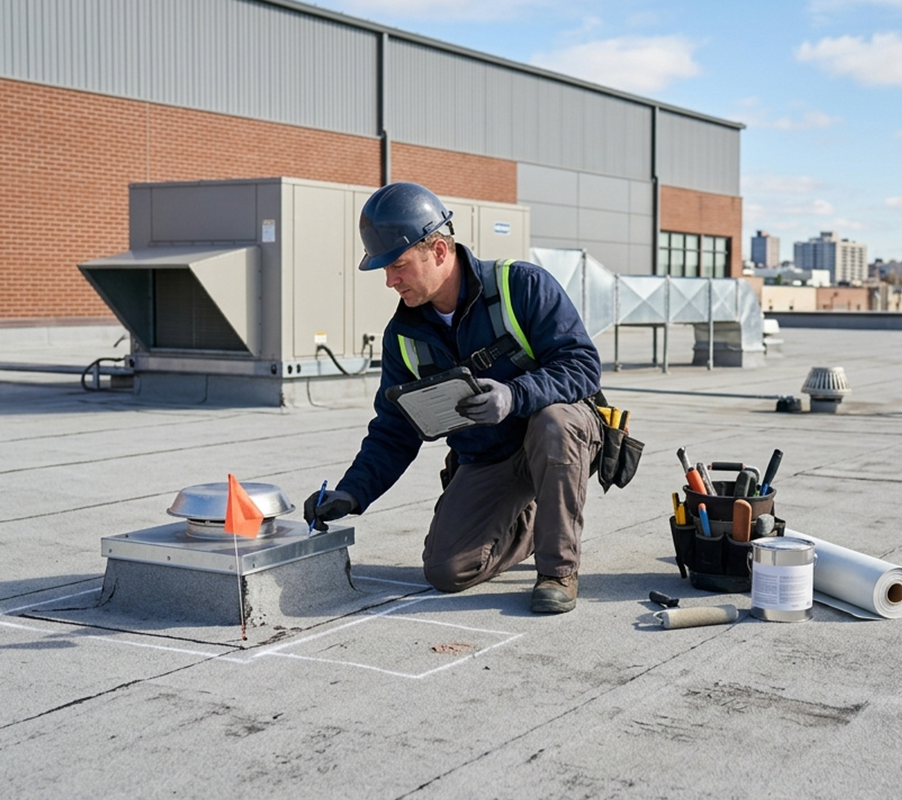
A practical inspection should include:
- Flashings at walls, parapets, curbs, and roof edges
- Seams and laps in the existing roofing
- Fasteners and metal joints
- Vents, pipes, drains, skylights, ducts, and other penetrations
- Cracks, splits, blisters, and previously repaired areas
- Transitions between different roofing materials
Water can travel beneath or through a roof assembly before it appears inside the building. The stain on a ceiling may help begin the investigation, but it does not necessarily identify the exact opening above it. If the source is uncertain, a qualified roofing professional should evaluate the condition before products are selected.
A coating does not replace detail preparation
Coating the field before addressing loose, cracked, open, or poorly adhered details can leave the original weakness in place. The better sequence is to determine whether the roof is a suitable restoration candidate, identify the repairs, and then prepare the surface for the selected system.
If that broader question has not been answered, begin with the practical pre-coating roof assessment. Once the roof qualifies, detail repairs become part of preparing a sound surface—not a separate cosmetic step.
Match the repair material to the roof system
“Roof cement,” “patch,” and “reinforcing fabric” describe different product roles. They do not mean that any one material can be used on every roof.
Before choosing a repair product, confirm:
- The type and condition of the existing roof
- Whether the repair area is dry, damp, or actively wet
- The kind of detail being repaired
- The coating or restoration system planned for the roof
- Whether reinforcement is part of the specified repair
The current product data sheet should control the decision. If the roof material or previous coating is unknown, pause and identify it rather than treating compatibility as an assumption.
Asphalt flashing cements serve specific repair needs
#75AF BULLDOG Heavy Duty Flashing Cement is an asphalt-based roof cement intended for repairs on clean, dry surfaces. Its documented uses include cracks, splits, blisters, metal surfaces, flashings, and details around parapets, skylights, vents, chimneys, ducts, and flues. For certain asphalt-roof repairs, the product data sheet calls for the cement to be used with a compatible reinforcing fabric.
#79AF BULLDOG SECUREFLASH is a rubberized flashing cement designed for wet or dry surfaces. That can be useful when conditions require a product documented for that purpose, but the wet-surface claim belongs to #79AF specifically. It should not be applied as a general rule to other BULLDOG cements, patches, primers, or coatings. #79AF also has roof-system exclusions, including coal tar, EPDM, and other single-ply roofs.
The practical lesson is simple: two products may both be described as flashing cement and still have different surface requirements and compatibility limits.
Reinforcing fabrics are not interchangeable
Reinforcement helps a compatible cement or coating bridge and strengthen designated areas, but the fabric must fit the repair and the system.
#201 BULLDOG Asphalt Saturated Cotton Fabric is documented for use with asphalt coatings and cements in applications such as cracks, laps, seams, flashings, parapets, and other patching work. It is a clear example of reinforcement used at localized roof details.
#272 BULLDOG Stitchbond Polyester Fabric and #326 BULLDOG Heavy Duty Polyester Mat serve broader reinforcing and resurfacing roles. They have their own substrate and system requirements; #326, for example, is documented for asphalt-base roofs rather than other roof types.
A contractor should select the fabric as part of a compatible assembly, not simply by choosing whichever roll happens to be available.
Silicone-system details require a silicone-compatible approach
BULLDOG Silicone Roof Patch is a high-build detail material designed for BULLDOG Silicone Roofing Systems. Its documented uses include penetrations, seams, fasteners, rough substrates, details, and transitions.
That does not make it a universal patch for every roof. The surface must be clean, sound, and completely dry, and any required primer must be selected and allowed to cure according to the system instructions. The patch also needs to cure before the subsequent coating is applied.
This is another reason to settle the roof and coating-system questions before starting detail work. The repair should belong to the same plan as the field coating.
Do not assume that every surface needs the same primer
Primer requirements can change with the substrate, its condition, and the selected repair or coating system. Some surfaces require a primer; others may not. The deciding source should be the current product data sheet, supported by the condition found during inspection.
For a plain-language explanation, see why roof-coating primers matter and when the data sheet calls for one.
A practical checklist before coating begins
- Confirm that the roof is a reasonable candidate for repair or restoration.
- Identify the existing roof membrane and any previous coatings or repairs.
- Inspect flashings, seams, fasteners, penetrations, parapets, and transitions.
- Mark open, loose, cracked, deteriorated, or questionable areas.
- Determine whether each repair area is dry, damp, or wet.
- Select repair materials that are compatible with both the roof and the planned coating system.
- Use reinforcement only where the product and system instructions support it.
- Complete the required preparation, repair, and cure steps before applying the field coating.
- Refer uncertain or extensive conditions to an experienced roofing professional.
Frequently asked questions
Can a field coating repair every roof leak?
No. A field coating should not be expected to locate or correct every opening at seams, flashings, fasteners, penetrations, or other details. Those areas should be inspected and repaired as part of the preparation.
Should seams and flashings be repaired before the roof is coated?
Open, loose, cracked, or deteriorated details generally need to be addressed before the field coating is applied. The exact repair depends on the existing roof and the selected system.
Can roof cement be applied to a wet surface?
Only when the selected product specifically permits it. #79AF BULLDOG SECUREFLASH is documented for wet or dry surfaces, while other products may require a dry—or completely dry—surface.
Can one patch product be used on any roof?
No. Asphalt, silicone, coal-tar, EPDM, and other roof systems have different compatibility requirements. Verify the existing roof and consult the current data sheet before choosing a patch.
When is reinforcing fabric used?
Reinforcing fabric may be part of a compatible repair or resurfacing assembly. The product, fabric, roof type, and coating system must be selected together.
Make the repair part of the complete roof plan
The best repair is not simply the one that fills an opening today. It is the one that fits the existing roof, addresses the vulnerable detail, and remains compatible with the restoration system planned for the field.
If you are deciding between flashing cement, silicone patch, reinforcing fabric, primer, and coating options, contact Palmer Asphalt. Share the roof type, the condition you found, whether the area is wet or dry, and the system you intend to apply. That information will make the product-selection conversation much more useful.